

How to Choose the Right Payment Processor for Your Business

Introduction: The Payment Processor Decision
Choosing the right payment processor is one of the most critical business decisions you will make. Whether you are launching a new e-commerce store, scaling a SaaS platform, or expanding globally, your payment infrastructure directly impacts your revenue, customer experience, and operational efficiency.
With thousands of payment processors available—each offering different fees, features, and geographic coverage—the selection process can feel overwhelming. This comprehensive guide breaks down everything you need to know to make an informed decision that aligns with your business goals.
Understanding Payment Processor Types
Payment Aggregators vs. Dedicated Merchant Accounts
Before comparing specific providers, you need to understand the fundamental types of payment processing:
Payment Aggregators (Stripe, PayPal, Square)
- How they work: Pool multiple merchants under one master merchant account
- Setup time: Minutes to hours—no lengthy underwriting
- Best for: Startups, small businesses, and companies needing quick setup
- Trade-off: Higher fees and less control over fund holds
Dedicated Merchant Accounts
- How they work: Your own direct relationship with an acquiring bank
- Setup time: Days to weeks—requires underwriting and approval
- Best for: High-volume merchants and established businesses
- Benefit: Lower fees, more stability, dedicated support
Learn more about payment orchestration vs traditional gateways to understand how modern solutions differ.
7 Key Factors to Evaluate When Choosing a Payment Processor
1. Pricing Structure and Transparency
Payment processing fees can significantly impact your margins. Look beyond the headline rate and understand all fee types including transaction fees (2.5% – 3.5% + $0.10-$0.30), monthly fees ($0-$99), chargeback fees ($15-$25), international fees (+1-2%), and PCI compliance fees ($5-$20/month).
2. Integration Complexity and Developer Experience
Consider your technical resources: API quality, SDKs available for your tech stack, pre-built plugins for Shopify/WooCommerce/Magento, and sandbox environment for testing.
If you are managing multiple integrations, consider payment orchestration to simplify your tech stack.
3. Geographic Coverage and Local Payment Methods
Where your customers are located matters immensely. For domestic focus, any major processor works. For global expansion, you need local payment methods like iDEAL in Netherlands, PIX in Brazil, and UPI in India. Local acquiring improves approval rates by 10-20%.
For global businesses, a single processor often is not enough. Learn how smart routing improves authorization rates across multiple providers.
4. Approval Rates and Reliability
Not all processors approve transactions equally. Authorization rates vary by 5-15% between providers. Look for 99.9%+ uptime SLA and failover capability. Even a 1% improvement in approval rates can mean millions for high-volume merchants. See how AI-powered routing maximizes approvals.
5. Settlement Speed and Cash Flow
Standard settlement is T+2 to T+7 (2-7 business days). Instant/next-day settlement is available from some providers for a fee. Watch for rolling reserves where processors hold 5-10% of funds as security.
6. Fraud Prevention and Security
Evaluate 3D Secure 2.0 support, machine learning fraud detection, tokenization for secure card storage, and PCI DSS Level 1 compliance.
7. Customer Support Quality
When payments break, you need help fast. Look for 24/7 support for global businesses, SLA for critical issues, dedicated account manager for high-volume merchants, and technical support for integration issues.
Top Payment Processors Compared
Stripe
Best For: Tech companies, startups, developers
Pros: Excellent API, extensive documentation, global coverage
Cons: Account freezes without warning for high-risk businesses
Pricing: 2.9% + $0.30 per transaction
PayPal
Best For: Small businesses, consumer trust
Pros: Trusted brand, massive user base, easy setup
Cons: Higher fees, held funds, limited customization
Pricing: 2.9% + $0.30 (higher for international)
Adyen
Best For: Enterprise, global omnichannel
Pros: Single platform for online + in-person, excellent global coverage
Cons: High minimum volumes, complex pricing
Pricing: Interchange++ (typically lower than flat rate)
Square
Best For: Brick-and-mortar, small retail
Pros: Easy in-person payments, no monthly fees
Cons: Limited international support
Pricing: 2.6% + $0.10 for in-person; 2.9% + $0.30 online
Authorize.Net
Best For: Traditional businesses, established merchants
Pros: Long track record, wide compatibility
Cons: Dated interface, requires merchant account
Pricing: $25/month + 2.9% + $0.30
Red Flags to Watch For
Long-Term Contracts with Early Termination Fees
Modern processors offer month-to-month agreements. Be wary of 3-year contracts with $500+ cancellation fees.
Tiered Pricing
This pricing model is opaque and often results in higher costs. Choose interchange-plus or flat-rate pricing.
Equipment Leases
Never lease credit card terminals. Buy outright for $100-300 instead of paying $40+/month for years.
Hidden Fees
Watch for: statement fees, batch fees, PCI non-compliance penalties, annual fees, and minimum monthly charges.
Poor Reviews on Fund Holds
Search “[Processor name] + account frozen” or “held funds.” Some providers are notorious for freezing accounts without warning.
Decision Framework: Choosing Your Payment Processor
Step 1: Define Your Requirements
Answer these questions: Monthly transaction volume? Average transaction size? Target countries/regions? Required payment methods? Technical resources available? Integration requirements?
Step 2: Shortlist 3-5 Providers
Based on your requirements, narrow down to providers that specialize in your use case. Startups/SaaS should consider Stripe or Paddle. E-commerce businesses should look at Stripe, Shopify Payments, or Adyen. Retail/POS should consider Square, Toast, or Clover.
Step 3: Request Quotes and Test
Get custom pricing based on your volume. Set up sandbox accounts. Test the integration experience. Evaluate support responsiveness.
Step 4: Plan for Growth
Consider where your business will be in 2-3 years. Will you expand internationally? Will transaction volumes increase significantly? Will you need additional payment methods? If growth and global expansion are likely, consider starting with payment orchestration to avoid painful migrations later.
When One Processor Is not Enough
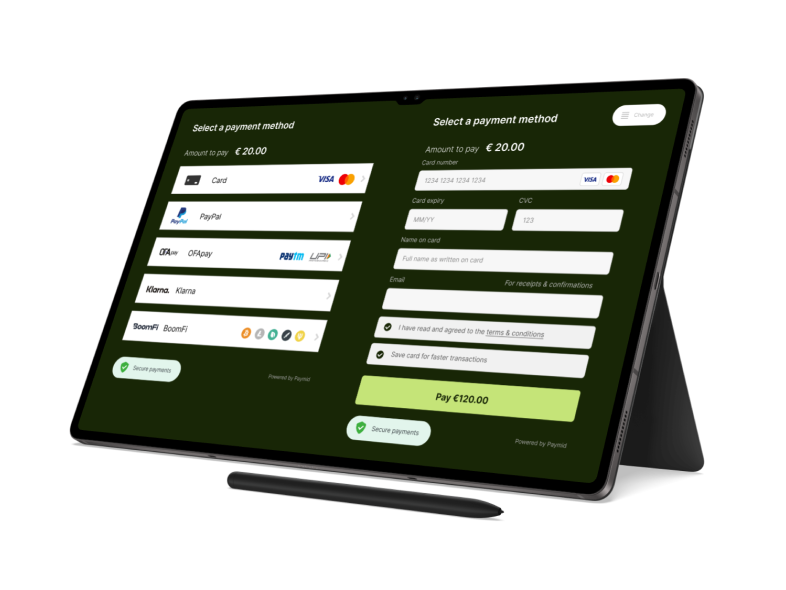
As your business grows, you may find that no single processor meets all your needs: Geographic coverage (one processor excels in Europe, another in Asia), payment methods (different processors support different local wallets), cost optimization (route low-risk transactions to low-cost providers), and redundancy (automatic failover when one processor has issues). This is where payment orchestration platforms like Paymid become essential—providing a single integration to manage multiple processors with intelligent routing.
Implementation Checklist
Once you have chosen a processor: Complete application and underwriting if required. Set up sandbox environment and test integration. Implement webhook handling for payment notifications. Configure fraud rules and 3D Secure settings. Set up reporting and reconciliation processes. Train customer support team on payment issues. Plan for PCI compliance if not fully outsourced. Create backup plans for processor downtime. Monitor approval rates and optimize over time.
Conclusion
Choosing the right payment processor is a strategic decision that impacts your revenue, customer experience, and operational efficiency. Take time to evaluate your options based on pricing, features, geographic coverage, and reliability—not just the brand name.
For businesses planning to scale globally or optimize payment performance, consider future-proofing your infrastructure with payment orchestration. A single integration with an orchestration platform gives you access to 700+ payment methods and the flexibility to add or switch processors without rebuilding your checkout.
Ready to optimize your payment stack? Contact Paymid to learn how our payment orchestration platform can help you maximize approval rates, reduce costs, and scale globally.
Related Articles:
- What is Payment Orchestration? The Complete Guide
- Payment Orchestration vs Payment Gateway
- How to Increase Payment Authorization Rates by 30%
- How AI is Revolutionizing Payment Routing
Last updated: February 2026

Matt Star
Matt Star is a Financial Markets professional with over 25 years experience across Institutional markets, Margin Forex, CFDs and Crypto. Located in Sydney, Matt is a well experienced and valued partner in Paymid Limited.